
1619
The immigrants' story

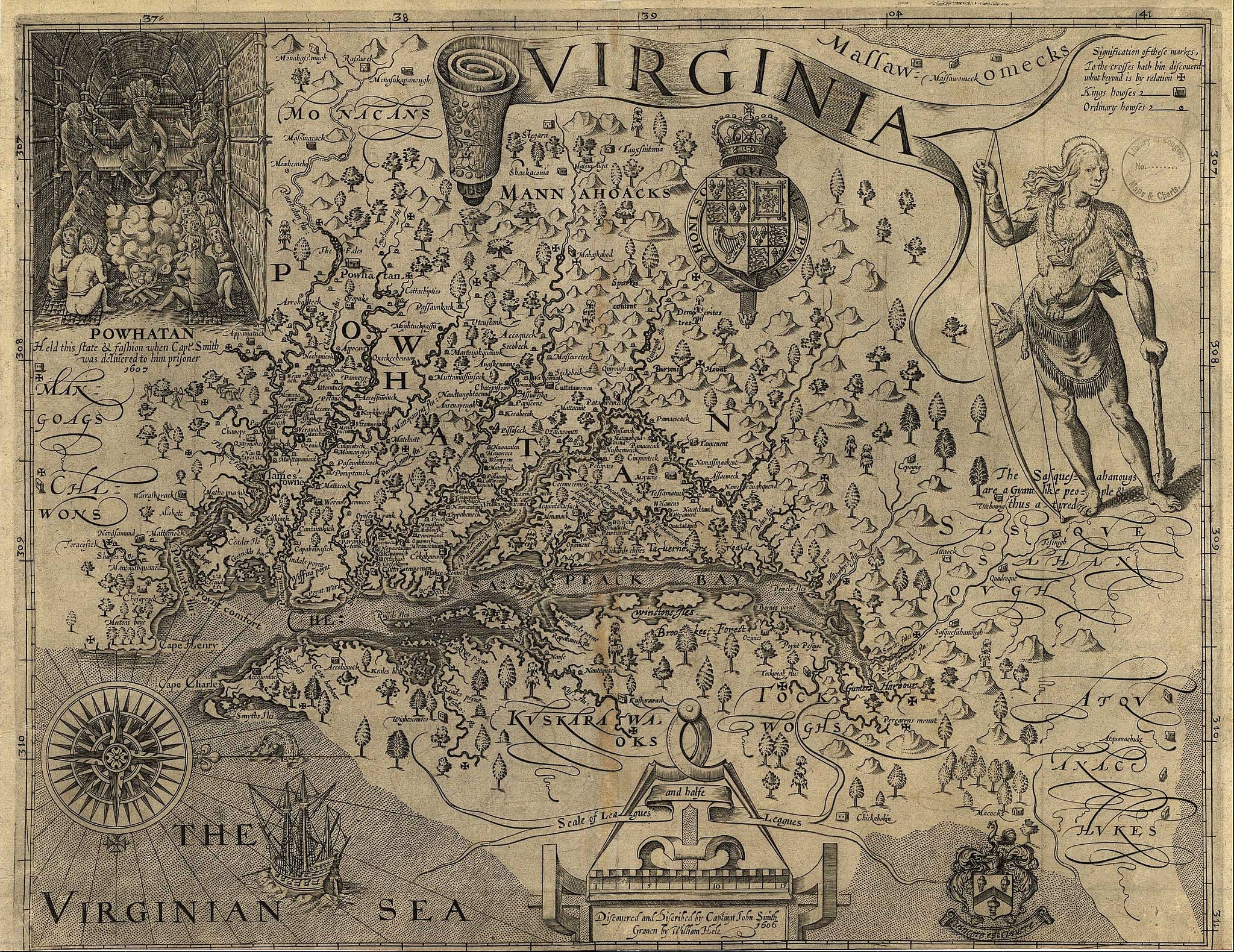
This week, a story about 1619.
Maybe you think you already know this story. 1619: the year when Virginia’s elites established an elected legislature, the first in the New World. 1619: the year when that same elite bought their first slaves, when pirates landed their ship in Jamestown’s harbor. All of which makes 1619 a year when the promise of American freedom was first whispered, and then almost immediately forever corrupted.
But there are still people missing from this version of the story. Immigrants. Immigrants were also there in Jamestown from the beginning. And I think their story — a story about living in the spaces that lie between black and white, about fighting for inclusion — also tells us something fundamental about America’s origins.
Of course — as the Powhatan would have been quick to point out four hundred years ago — everyone arriving in boats from Europe to land on the shores of their river were immigrants. But the first 104 settlers to arrive in Jamestown in the Spring of 1607 under the leadership of Captain John Smith were all English men and boys — and these Englishmen understood Jamestown to be an English place. Yes, they were settlers in a New World: but inside the limits of their fledgling English colony, they were natives, not foreigners.
Within a year of their arrival it was clear that Jamestown had a problem: it lacked a suitably skilled workforce. English craftsmen were not used to working in virgin forests (the English had already cut their own forests down centuries before). Their solution was to recruit immigrants from across Europe. Jamestown’s need for skilled workers would be met by paying low wages to talented foreigners.
This was why in 1608 a group of eight Polish and “Dutchmen” workers arrived in the English colony, recruited by the settlers as specialist tradesmen. Other migrants soon joined the Poles and Dutchmen, similarly recruited for their artisanal skills. Italians were hired to make glass; Frenchmen to instruct English colonists in how to cultivate vines and silkworms.
National distinctions were fuzzy in the the early seventeenth century. The migrants known as “Poles” in fact came from all over Eastern Europe and the Baltic. The “Dutchmen” mentioned in these records were probably from the Netherlands, although some historians think they were actually Germans. But what is clear is that, to the English, these men were foreigners: immigrants. They were not English.
What is also clear is that these immigrants helped to build Jamestown: the colony survived because of them. Although the total number of immigrant workers in early Jamestown at any one time was never very high — perhaps at most a few dozen among a total population numbering a few hundred — historians agree that their role in establishing the infrastructure of the settlement was essential.
Some of these immigrants found a warmer welcome than others. John Smith wrote admiringly that “Dutchmen and Poles” were among the few settlers (English included) who “knew what a dayes work was”. In contrast, the Italian recruits who arrived in 1620, brought from Venice to serve as master glassmakers, were despised. “A worse crew hell never vomited”, wrote their English patrons.
Yet many of the foreign arrivals in Jamestown felt exploited. Half arrived as indentured laborers, workers who — in return for the Virginia Company paying for their passage to America — now found themselves bound in service for several years. In this respect, the immigrants were just like the English. They were all chasing wealth; all ensnared by a new American dream; all lured to Virginia by the promise of land.
In the meantime, they were held in barracks, a semi-captive immigrant workforce held to exacting terms of service. For the English weren’t interested in foreigners’ landowning ambitions. In their view immigrants were workers — not future citizens. So on the completion of their contracts — typically after seven years in Virginia — the Polish residents of Jamestown found themselves still barred from owning land in the colony.
This is how we arrive at 1619. As the colony’s elites prepared for self-government, for Jamestown’s immigrants the possibilities of 1619 hinged on the the question of whether they belonged. Could an immigrant — a foreigner — become a Virginian? Own land? Vote?
The Englishmen writing the Commonwealth’s new rules said no.
The immigrants had other ideas.
What happened next was remarkable. In the summer of 1619, Jamestown’s Poles put down their tools, refusing to work until it be recognized that they had a right to vote and own land as equal Virginians. More remarkable still: the strike was successful. Withholding their labor, the immigrants won. On 21 July 1619, the Virginia Company of London recorded that; “Upon some dispute of the Polonians resident in Virginia, it was now agreed (notwithstanding any former order to the contrary) that they shall be enfranchised, and made as free as any inhabitant there whatsoever”. Immigrants’ collective action had won the vote.
It’s tempting to stop here: to write the story of Jamestown’s immigrants as a triumph for the rights of man, a lesson in the power of organized labor. But that’s wishful thinking, just like calling the Poles ‘as free as any inhabitant’ in 1619 Jamestown. It was just weeks after the Polish workers won their enfranchisement that the first ships arrived in Jamestown, selling trafficked African slaves.
Nonetheless, I think these immigrants’ story — the tale of the Polish builders who helped make an English colony viable, striking to secure their rights to a future in Virginia — still matters when we talk about 1619.
Why? First, because this story is a reminder that immigrants — people seen as foreign, people seen as no more than the sum of their labor — were here in America right from the very beginning, fighting to be included in the community they helped to sustain. It’s also a reminder that America, even in its earliest days, only became a ‘nation of immigrants’ in spite of itself, because immigrant workers insisted they not be written out of the narrative.
The story of 1619’s immigrants also says something about how quickly race became the category that defined freedom. The Poles were white: their admission to the Commonwealth as eligible landowners confirmed the importance of race as a dividing line even as it erased differences of nationality. Brown immigrants wouldn’t have the right to become America citizens for another 350 years.
All this means the immigrant story in 1619 is complicated. But that’s exactly why the story of Jamestown’s Poles matters. 1619 is, more than anything, a story about the drawing of lines, about exclusion and inclusion, about freedom and unfreedom. In contesting where those line were draw, the story of Jamestown’s Poles tells us something about their artificial construction — and about the extent to which immigrants have always had to negotiate their own way to belonging in America.
Read
‘Abstract of the Proceedings of the Virginia Company of London’, 21 July 1619. In Collections of the Virginia Historical Society, Volume 7, 1888, p.17
Appelbaum, R., & Sweet, J. W. (Eds.). (2012). Envisioning an English Empire: Jamestown and the Making of the North Atlantic World. University of Pennsylvania Press
Orli, R.J., 2008.’ The identity of the 1608 Jamestown Craftsmen’. Polish American Studies, 65(2), pp.17-26.
Pula, J. S. (2008). ‘Fact vs. Fiction: What do we really know about the Polish presence in Early Jamestown?’, The Polish Review, 53(4), 477-493, p.478
Smith, John, (1907) ‘The Generall Historie of Virginia. New England and the Summer Isles’, MacMillan, New York. Available online
Warder, B. ""From Forraine Parts": Non-English Europeans at Jamestown, 1607-1625" Historic Jamestowne. National Park Service.