
600 Sons
How the 1906 Earthquake saved San Francisco's Chinatown

(You can read Part I of this story here)
Earthquake
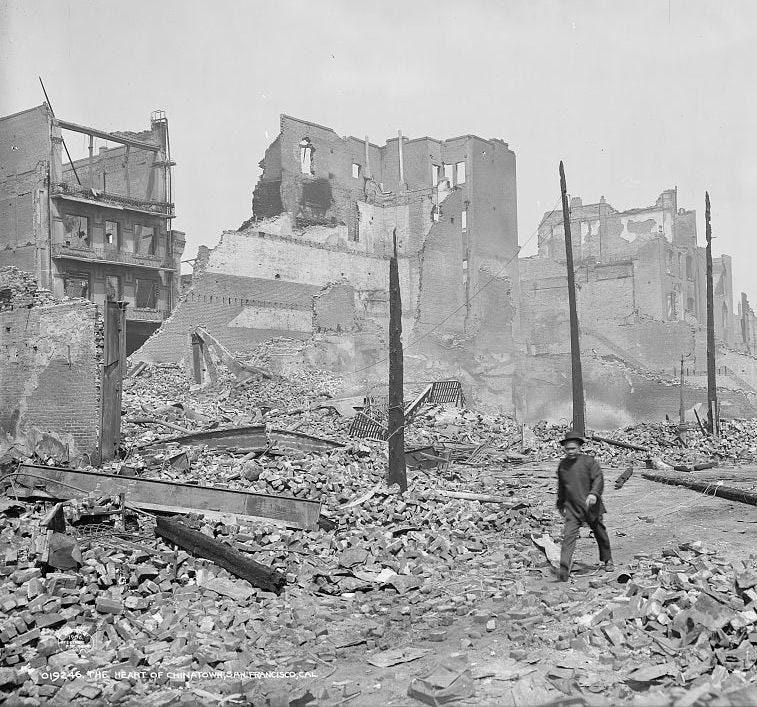
At first it looked like disaster. The earthquake that shook San Francisco to the ground on 18 April 1906 reduced Chinatown — like most of the rest of the city — to rubble. The city’s Chinese residents were displaced to segregated refugee camps in the foggiest and most isolated corner of the Presidio.
After the earthquake came the fires. San Francisco’s City Hall had collapsed in seconds during the quake: now the city’s official records were destroyed. But it was from these ashes that an unexpected opportunity arose. In an attempt to recreate its paper records, San Francisco asked all its citizens to come and register their presence.
The Chinese community in the City quickly realized this request opened a window. Wong Kim Ark was American law: all those born in the US were American citizens. With the records burnt, who could now disprove a claim by any Chinese resident of the city to have been born in San Francisco before the earthquake?
So the Chinese went to City Hall. It was obvious most who claimed citizenship were doing so fraudulently. Some estimates suggest that if every Chinese migrant claiming to be American-born in 1906 had been telling the truth, every Chinese woman in San Francisco before the earthquake struck would have had to have given birth to 600 sons. But nonetheless, the authorities chose not to peremptorily challenge these claims. San Francisco’s Chinese community was able to successfully recreate a record of itself as American-born citizens.
Paper Sons
At first glance, this sleight-of-hand secured the Chinese immigrants already in the US some extra protections in a rabidly anti-Asian state. But in fact, what proved still more important in the long-term was the web that extended backwards into China. Many of those who registered as American-born at City Hall also registered the births of their own sons and daughters in China. And as the children of American citizens, these Chinese-born children were also Americans — even if they had never (yet) set foot on American soil.
Some of these claims were true: others were not. But Chinese Americans in possession of documents showing the existent of their Chinese-born “paper sons” (and daughters) could now return to China and sell these identities to other would-be immigrants. Chinese migrants — thwarted by racist, restrictionist immigration laws — were now able to enter America with false papers, claiming entry as citizens.
The scale of the arrivals could hardly go unnoticed. Officials quickly realized that there were plenty of imposters on the boats arriving in the harbor. Many Chinese occupied their time on the voyage memorizing coaching books. These crib notes — used to help “paper sons” memorize the finest of details of their assumed life: the number of rooms in a house, the building materials used, the relationships of grandparents and cousins and neighbors — were supposed to be thrown overboard or hidden before arrival at the island. These minutiae were a passport into America. But occasionally they were discovered, and instead served as proof of organized attempts to fool immigration officials. Exposed, these would-be immigrants were deported.
Initially, up to 400 of these Chinese immigrants at a time were routinely crowded into a “detention shed” on the Pacific Mail Steamship dock at Pier 40 in San Francisco. But conditions in the warehouse were universally recognized as appalling. So a decision was taken to build a new immigration station: Angel Island. Today, the ruins of the immigration station still stand as a monument to a time when the America’s Golden Gate offered no welcome to Asian immigrants.
Angel Island
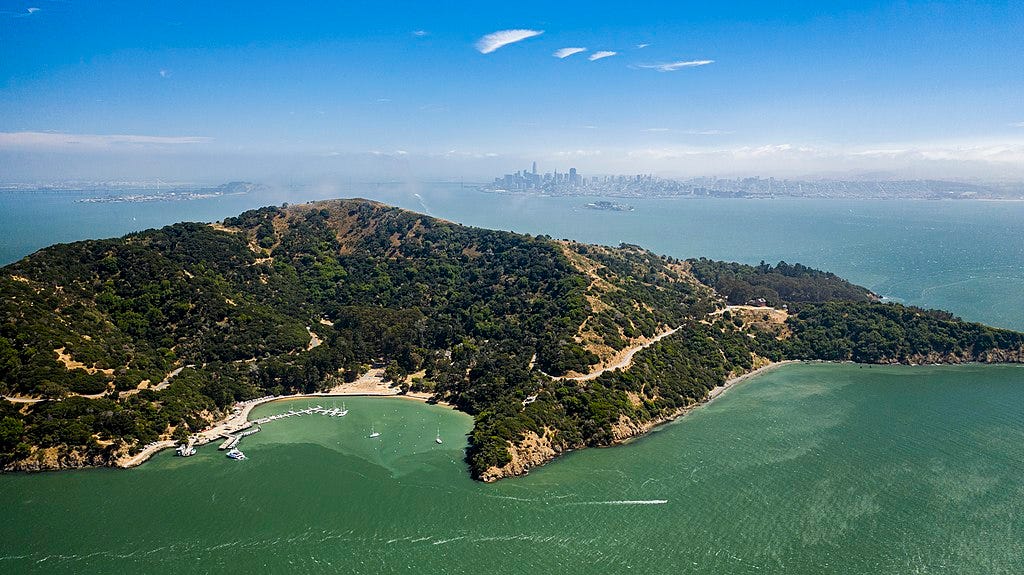
Between 1910 and 1940, a million aspiring immigrants landed on Angel Island; 300,000 were detained here; a few were incarcerated for nearly two years. Marking time, detained immigrants carved poems on the walls of the immigration bunkhouses, speaking of fear and anger: ‘America has power, but not justice. In prison, we were victimized as if we were guilty’; ‘Instead of remaining a citizen of China, I willingly became an ox.’
Newspaper reports from the time were resolute: Angel Island was intended to guard San Francisco from “the evil, the peril, the danger of immigration — the casting upon western shores the spawn of the earth”. It was intended as a barricade against “the rising tide of Oriental Invasion… Orientals who are rotten with contagion of the body, diseased in mind, lepers in morals”.
Though the vast majority of those detained were from China, other Asian migrants — Japanese, Filipinos, Indians — were also subject to similar interrogations, as were Russians and Latin Americans suspected of being revolutionaries or refugees. Upon arriving at the island, the immigrants were separated by gender and by race (the first class passengers were usually given a cursory examination on the steamship, and spared the indignity of visiting Angel Island at all). Most of those whose papers were in order — white migrants, returning merchants and students — were cleared to land within a few days.
Others — above all those suspected of being Chinese workers masquerading as the sons of American citizens — could be detained for weeks or months. The US immigration service would call white witnesses from the city to offer supporting testimony: when migrants’ claims were rejected, Chinese-hired white lawyers filed urgent appeals.
If the screening process on Angel Island is judged on its ability to detect “paper sons”, it was an abject failure. Detained Chinese migrants and their witnesses were subject to extraordinarily detailed and repeated questioning, but without computers the task facing immigration authorities was near impossible. Both former detainees and immigration inspectors estimated that around 90% of those who came through Angel Island held false papers. Only a small fraction of these migrants — about 15% — were actually rejected and deported.
Investigating these cases at the San Bruno national archives — where over a million files relating to Chinese exclusion are held — there’s plenty of evidence of Chinese immigrants being given the benefit of the doubt. Low Tim, for instance, was a 16 year old boy who arrived in San Francisco on 28 September 1913. He applied for admission as the son of a native-born Chinese American citizen and was held at Angel Island for nearly a month. During that time was questioned multiple times by inspectors.
Archives show the interrogations began simply: Low Tim was asked to state his age, his date and his place of birth. But the questions quickly became more obscure. How many wives did your paternal grandfather have? Did your neighbor’s wife have natural or traditionally-bound feet? How many rooms were in your house? How large was the skylight in your bedroom, and did your brothers sleep in the same room?
The inspector in the case, Philip Jones, did not believe Low Tim was the son of the man who claimed to be his father, Low Jin. After several interviews, his final report concluded that ‘if there is any relationship at all between the applicant and the alleged father, it is more likely that of uncle and nephew than father and son’.
But instead of a deportation order, Jones’ issued a more unexpected — a more compassionate — recommendation: ‘I do not feel that the foregoing cited discrepancies are of importance sufficient to base a recommendation for denial… I therefore submit this case reluctantly with a favorable recommendation.’
Low Tim was released on 22 October, to begin a new life in America.
That kind of discretion is impossible to imagine in today’s world of biometrics and visas and ICE raids. But just as the residence of 11 million undocumented migrants is today baked into the economic and social fabric of the US — their presence in the shadows acknowledged fact, an open secret — in 1920s San Francisco, everyone knew that irregular Chinese immigrants could slip through Angel Island and find refuge in Chinatown. Once released from Angel Island, many “paper sons” lived their entire lives within the boundaries of these Chinese neighborhoods, concealing the fabrication of their identities from their American-born children.
Tell Me How It Ends
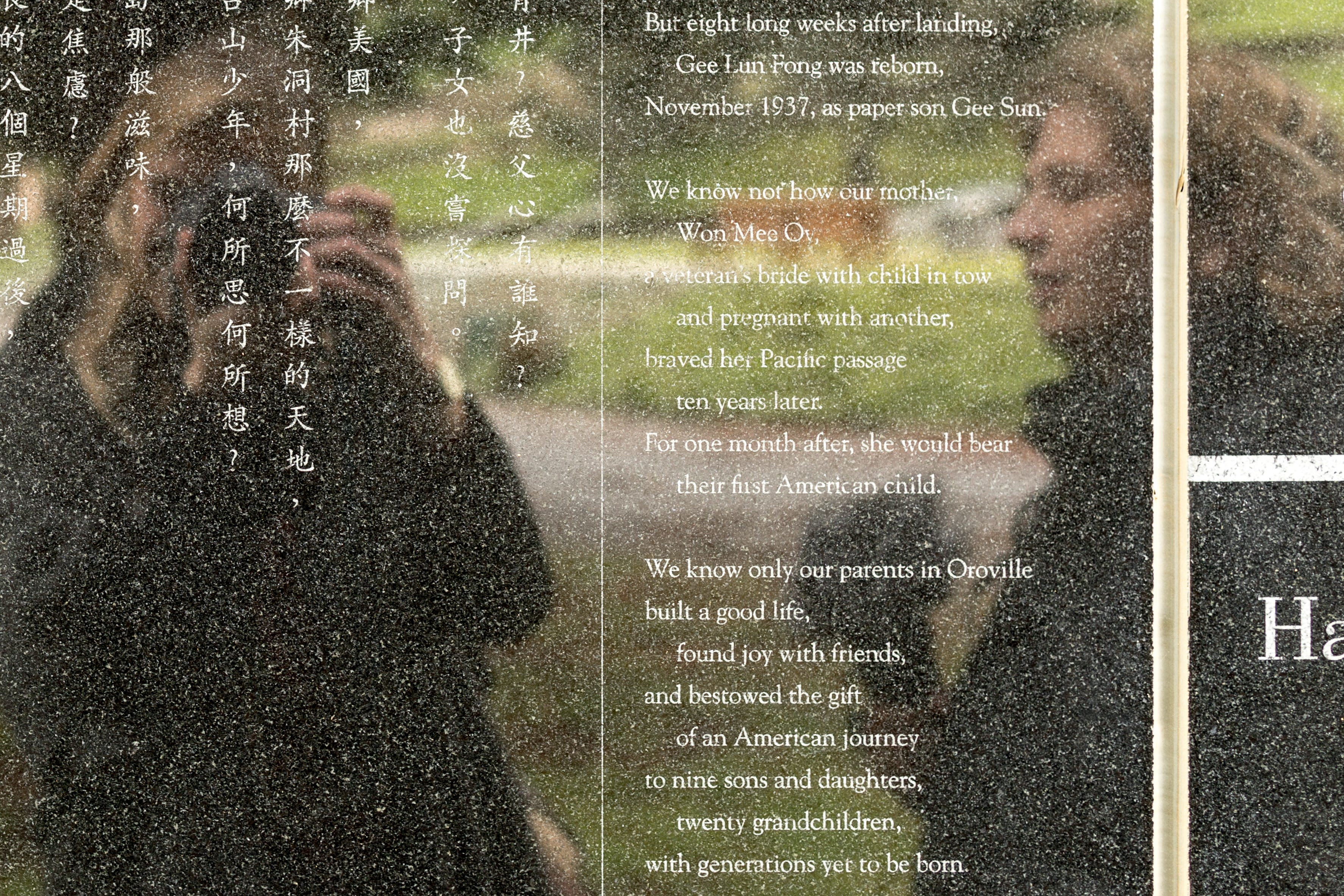
There was no single moment of enlightenment that ended Asian Exclusion. The laws softened incrementally. In 1943 Congress allowed 105 Chinese migrants to enter each year, as a token recognition of China’s role as a wartime ally against Japan. It wasn’t until 1965 that the new Immigration and Nationality Act swept away racist “origins” quotas, and significant Chinese migration began once more.
The children of the Paper Sons found their footing, became Americans. Today — outside the building where poems etched in Chinese characters record the anger and dejection of the detained migrants — new poems commemorate the gratitude of those immigrants’ descendants: ‘In honor of our courageous grandparents, whose dreams became our reality.’
The San Francisco I know — my white liberal bubble — doesn’t talk much about the history of Exclusion; doesn’t know much about it to begin with. Instead, the City prefers to point to the progress that came after the 1960s, when Asian students were among those who organized in San Francisco to demand their Civil Rights. Today, 1 in 3 city residents are of Asian descent, and the Chinese community wields considerable political and economic power. Today, San Francisco does not persecute undocumented migrants but consistently attempts to protects these immigrants from Federal overreach.
But that's not where the story ends. The progress is real — but it’s not yet complete. For all the talk of diversity, San Francisco remains at the neighborhood level a very segregated city. There’s been a rise in anti-Asian hate crime recorded by city police in the past year, as right-wing media and President Trump insisted on labelling COVID-19 the “China Virus” and “Kung Flu”. San Francisco, in other words, is not so very far away from the rest of America, from that parallel Republican-voting universe. It is certainly less far away than it would like to think.
And this is exactly why we should tell the story of how San Francisco has always been a city of immigrants — but also, very often, a city of xenophobes. For it’s in the intersection of these two stories that there’s hope. Told together, San Francisco’s history shows today’s hardline anti-immigration views elsewhere aren’t inevitable or fixed or immovable elsewhere in American either. It provides some evidence that —while it moves far too slowly — the arc of the moral universe can eventually bend towards justice.
But oh, we still have so much work to do.
Read More
Chin, Tung Pok, and Winifred C. Chin. Paper son: One man's story. Vol. 216. Temple University Press, 2000.
Gyory, Andrew. Closing the gate: Race, politics, and the Chinese Exclusion Act. Univ of North Carolina Press, 1998.
Lai, Mark H. Genny Lim, and Judy Yung, eds. Island: Poetry and history of Chinese immigrants on Angel Island, 1910-1940 . San Francisco Study Center, 1980.
Lee, Erika, and Judy Yung. Angel island: Immigrant gateway to America. Oxford University Press, 2010.
Lee, Erika. "The Chinese exclusion example: Race, immigration, and American gatekeeping, 1882-1924." Journal of American Ethnic History (2002): 36-62
Lee, Erika. At America's gates: Chinese immigration during the exclusion era, 1882-1943. Univ of North Carolina Press, 2003.
Ngai, Mae M. "Legacies of exclusion: Illegal Chinese immigration during the Cold War years." Journal of American Ethnic History (1998): 3-35
Yung, Judy, Gordon Chang, and Him Mark Lai, eds. Chinese American voices: From the gold rush to the present. Univ of California Press, 2006.
Yung, Judy. Unbound feet: A social history of Chinese women in San Francisco. Univ of California Press, 1995.
Visit
Angel Island Immigration Station - https://www.aiisf.org
Chinese Historical Society of America - https://chsa.org
***